
Sciatica: symptoms, causes and when it stops being "just pain"
Most sciatica improves without surgery. The difficulty is recognising in time the cases that do not.
The question is not whether you have a herniation. It is whether that herniation explains your symptoms, and whether time will resolve it.
Between the vertebrae sit intervertebral discs acting as shock absorbers. Each has a tough outer fibrous ring and a gel-like inner nucleus.
A disc herniation occurs when the ring tears and part of the nucleus displaces outside its place. The problem is not the displacement itself: it is that this material can compress a nerve root and trigger radiating pain, numbness or weakness.
| Type | What happens | Usual behaviour |
|---|---|---|
| Protrusion | The disc bulges, the ring stays intact | Frequently asymptomatic |
| Extrusion | The nucleus passes through the ring but stays connected | Symptomatic more often |
| Sequestration | A fragment separates completely | Very symptomatic, but high rate of spontaneous reabsorption |
There is a useful paradox: larger, extruded herniations tend to reabsorb better than small contained protrusions. The body recognises the free fragment as material to clear and reabsorbs it. So a dramatic-looking herniation on MRI can have a better natural outlook than a modest one.
The great majority of lumbar herniations are at L4-L5 and L5-S1, the levels bearing the most load and movement.
| Root | Where it is felt | Typical weakness |
|---|---|---|
| L4 | Front of the thigh and inner leg | Knee extension |
| L5 | Outer leg to the top of the foot and big toe | Lifting the foot and big toe (foot drop) |
| S1 | Back of thigh and calf to the outer border of the foot | Standing on tiptoe |
In the absence of red flags, the recommendation is conservative treatment for 6 to 12 weeks before considering surgery. The reasoning is solid: within that period a significant proportion of patients improve substantially without an operation.
The third point carries a frequently overlooked condition: the imaging must correlate with the physical examination. If pain follows the L5 distribution and the herniation compresses S1, the diagnosis needs review before operating.
Compared with continuing to wait, surgery offers faster and more predictable relief of leg pain. What the evidence shows is that several years later both groups converge; what surgery mainly changes is the speed of improvement. So the key question is: what is this pain costing you right now, at work, in your sleep, in your life?
Endoscopic variants reduce the incision further. Technique choice depends on fragment location, patient anatomy and the team's experience. We expand on this in our article on minimally invasive spine surgery.
| Timeframe | Usual sequence |
|---|---|
| Day of surgery | Walking the same day. Leg pain usually improves immediately. |
| 1 – 2 days | Hospital discharge in most cases. |
| 2 – 4 weeks | Return to desk work. Progressive walking. |
| 4 – 6 weeks | Start of strengthening physiotherapy. |
| 6 – 12 weeks | Return to physical work and sport, depending on progress. |
Residual numbness can take longer to resolve than pain, because the nerve needs time to recover after being compressed. The longer it was compressed, the slower that recovery tends to be — another argument for not letting a motor deficit drift.
No. Most improve with conservative treatment within 6 to 12 weeks, as the herniated fragment dehydrates and is reabsorbed. Surgery is reserved for cauda equina syndrome, progressive motor deficit, and disabling radicular pain persisting despite correct treatment.
Yes. It is a well-documented phenomenon: the body reabsorbs herniated material over weeks or months. Interestingly, larger extruded herniations tend to reabsorb better than small contained protrusions, because the free fragment is recognised and cleared more efficiently.
Recurrence at the same level happens in a small percentage of patients. When it does, the whole case is reassessed: sometimes a repeat microdiscectomy suffices, and on other occasions, if there is associated instability, adding stabilisation is considered. Returning pain should always be investigated, never assumed normal.
Yes, and it is advisable. Heavy lifting and sudden bending-with-rotation should be avoided in the acute phase, but staying active is better than rest. Walking, swimming and progressive core work under physiotherapy supervision are the usual options.
No. Only the herniated fragment compressing the nerve is removed, not the whole disc, and minimally invasive technique splits the muscle rather than cutting it. Segment stability is preserved, which is why screws are not placed in the vast majority of these cases.
Written and reviewed by Dr. Ricardo Bermúdez, neurosurgeon. Last reviewed: 2026-09-09.
General informational content. It is not medical advice, does not create a doctor-patient relationship, and must not be used to self-diagnose or to decide on treatment. Outcomes vary from person to person. If you have symptoms, see a doctor.
Most sciatica improves without surgery. The difficulty is recognising in time the cases that do not.
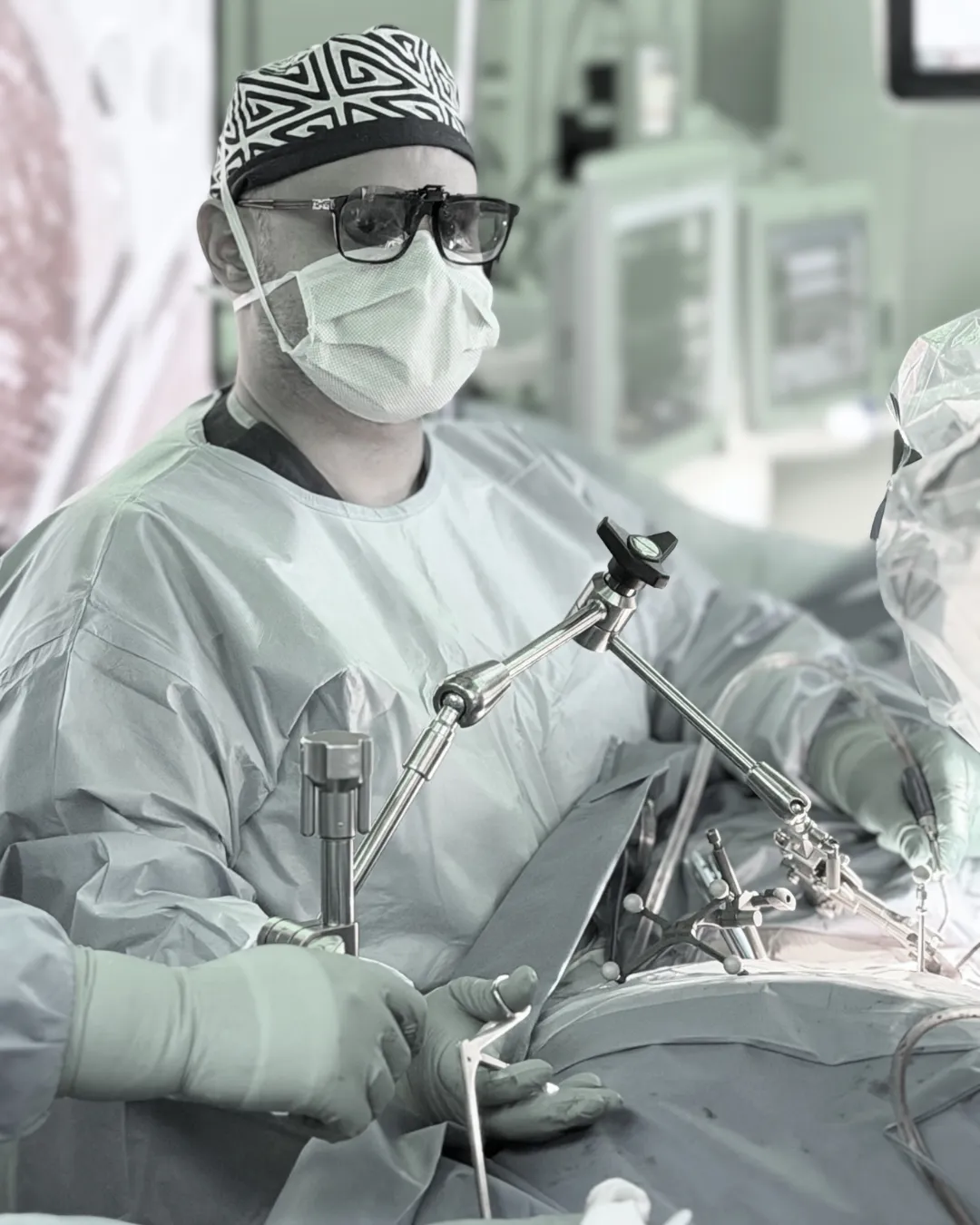
It is not "laser surgery" and it is not risk-free. It is the same operation, performed through a smaller door.
In most low back pain no specific structural cause is identified. And most of it still gets better.